I've been percolating on this one for a week or so now, but want to share it with you all because I need some other opinion.
In a session on peri-operative care, one of the consultants said that it was no longer 'normal practice' to order a chest Xray prior to an operation. Previously, JHO's and Fy1's had always ordered one for the anaesthetist. However, since the Surgeon didn't need it, and the anaesthetist usually didn't need it, the reports attached to the Xray were not read, and on occasion, small tumours etc were missed, which were later investigated and the Radiologist report read "the mass seen on dd/mm/yyyy has enlarged". The family got upset that no one had read the report of the original mass, and sued the NHS.
The consultant then went on to say that we should also never order blood tests that we did not need for the current management of the patient, because if we found an adverse result we would have to act on it.
I guess this comes down to 2 main questions:
a) should NHS hospitals be screening people for common ailments just because they have been admitted with a different condition.
b) if a hospital finds an adverse result and commences management as an in-patient, does the hospital pay instead of the PCT.......
Some patients do seem to fall through. we saw a lady with gallstones who had an irregularly irregular pulse. to us Med students that indicates AF. Yet despite having her pulse taken every 4hours, no one had noted the rhythm/character or done an ECG (she was admitted via GP not via A&E). She was due an operation at the tail end of last week, so it will be interesting to see if she received an ECG / cardiology referral, or if the anaesthetist was the first to notice in theatre! If so, might it be the downside of the assertion that investigations should not be carried out unless necessary. no-one thought it necessary, and they have to deal with the result.
Similarly, we saw a patient on an orthopaedic ward who had a BP of 180/100mmHg, despite being on triple therapy for Hypertension (Angiotensin 2 receptor antagonist, Calcium channel blocker and ACE inhibitor), and despite an inpatient stay of 2 weeks, had not had a review done by anyone from the Medical side of the hospital.
Conversely some departments are very good. Especially those with links. Vascular wards are quite good for getting cardiology to come and check out patients who display any cardiac signs - many get ambulatory ECG or 24hr recording monitoring to establish the nature of any cardiac complaint. But again vascular and cardiology are very closely linked physiologically and pathologically.
Showing posts with label anaesthesia. Show all posts
Showing posts with label anaesthesia. Show all posts
Sunday, October 19, 2008


Wednesday, August 8, 2007
Elective - day 11
My final day in Anaesthetics came round very quickly. I was once again in plastic surgery.
The SpR who was looking after me today also had a trainee SpR with him. We went to see a few patients and do anaesthetic assessments - one lady had a suspected ejection systolic murmur (Aortic Stenosis) and she had to have an echo before her surgery.
The actual theatre list started at 10am, and because the plastic surgeon was otherwise occupied in the morning, our theatre was helping with the trauma list. So we had a haematoma evacuation to do, and a crushed finger repair. in both cases the patients had been in for a few days and so they already had venflons in, so I couldn't practice my technique.
My supervisor said that all the Anaesthatists I had been in theatre with had been pleased with my performance and said that they had enjoyed having me as a student. he wished me the best of luck in my exams, took the Elective assessment sheet off me and sent me home about 3!
The SpR who was looking after me today also had a trainee SpR with him. We went to see a few patients and do anaesthetic assessments - one lady had a suspected ejection systolic murmur (Aortic Stenosis) and she had to have an echo before her surgery.
The actual theatre list started at 10am, and because the plastic surgeon was otherwise occupied in the morning, our theatre was helping with the trauma list. So we had a haematoma evacuation to do, and a crushed finger repair. in both cases the patients had been in for a few days and so they already had venflons in, so I couldn't practice my technique.
My supervisor said that all the Anaesthatists I had been in theatre with had been pleased with my performance and said that they had enjoyed having me as a student. he wished me the best of luck in my exams, took the Elective assessment sheet off me and sent me home about 3!
Friday, August 3, 2007
Elective - days 9& 10
Day 9
Today I was in vascular surgery. The anaesthetic stuff went quite well and I got to do a couple of venflons and intubations.
One of the registrars also told me a really simple way to look at blood gases and pH and work out whether a patient had an acidosis or alkalosis and whether it is respiratory or metabolic. If is a very simple 4 step approach which no text book has but it works very well. All in all it was a useful way to spend the 3 hours of the second operation; during the first one we had gone over ECG patterns and the pyramid of analgesia.
Day 10
Today I was back in ICU. This entailed following a ward round which was very interesting, as in the case of 4 of the 6 patients, the doctors had no idea what was actually wrong with the patients, nor why some of their biochemistry was so disordered. i also spoke to the ICU staff about the possibility of doing an SSM there - I need to send an email this weekend!
There is one day of my elective left, next Tuesday, as I have the Wednesday off for revision for the exams on Thursday and Friday.
Today I was in vascular surgery. The anaesthetic stuff went quite well and I got to do a couple of venflons and intubations.
One of the registrars also told me a really simple way to look at blood gases and pH and work out whether a patient had an acidosis or alkalosis and whether it is respiratory or metabolic. If is a very simple 4 step approach which no text book has but it works very well. All in all it was a useful way to spend the 3 hours of the second operation; during the first one we had gone over ECG patterns and the pyramid of analgesia.
Day 10
Today I was back in ICU. This entailed following a ward round which was very interesting, as in the case of 4 of the 6 patients, the doctors had no idea what was actually wrong with the patients, nor why some of their biochemistry was so disordered. i also spoke to the ICU staff about the possibility of doing an SSM there - I need to send an email this weekend!
There is one day of my elective left, next Tuesday, as I have the Wednesday off for revision for the exams on Thursday and Friday.
Friday, July 27, 2007
Elective - days seven and eight
Day 7 - Thursday
Today I was in lower limb orthopaedic surgery. The consultant was very friendly and the SpR with her was the one whom i had been with to do the hip screwing on Wednesday. I did another 3 venflon drip insertions, two of which were successful first time, and one of which wasn't! I also spent a bit of time holding face masks and trying to insert the LMA breathing tubes, which is much trickier than you might think!
The theatre being used today was up in the old part of the hospital and had a huge curved bay at one end with many windows, with a lovely view of the multi-storey car park and the back of the new building at the hospital. The operations were fairly simple, but the consultant surgeon still quizzed me about the nerves of the lower limb whilst he was blocking them with local anaesthetic. I doubt i will ever forget that the sagital nerve invervates the thigh and the femoral nerve innervates the lower leg through its two branches - common peroneal and tibial branches.
The regional anaesthetic idea is a good one, since injecting the anaesthetic into the nerve at the top of the leg gives complete pain relief (but also some loss of feeling a movement) for up to 2 days following the operation. this lessens the need for the patents to be on opiate painkillers, which can make them feel sick.
handily, this list was finished by 2.30pm, so i got an early finish.
Day 8 - Friday
Today I was with one of the SpR's for urology surgery. there were only two cases on the morning list, and the first lady was already anaesthetised when I arrived (on time) at 8.55am. Thus I got to see how the monitoring of her operation was different because she was having a kidney operation, and thus needed to lie on her front (prone). She was quite ill and had many previous operations, so when the surgeons discovered she had pus in her kidney, they decided to abort the planned procedure, give her antibiotics and wait until the infection cleared up before attempting the operation again.
The second man was very anxious. he was only having a spinal anaesthetic, because in the past he has reacted very badly to a general anaesthetic. The operation went off fine, with him feeling no pain. However, as we started to disconnect the monitoring, he complained of chest pain around the bottom of his ribs. His ECG and blood pressure were normal, so we could rule out a heart attack. the surgeons came back to check on his operation, but that was way down in his bladder, so it seems unlikely that it was connected to the pain. The man was also sick and sweating, but his blood sugar level was normal. An Chest X-Ray was inconclusive, and so the SpR ordered some blood tests. We then had a fun tutorial on fluid balance, acid-base balance, heart conditions, and muscle relaxant drugs. the patient had still not improved, so I was sent home as there was no afternoon list, and no obvious 'medical' or 'surgical' cause of the pain, so the man was just on close observation.
Today I was in lower limb orthopaedic surgery. The consultant was very friendly and the SpR with her was the one whom i had been with to do the hip screwing on Wednesday. I did another 3 venflon drip insertions, two of which were successful first time, and one of which wasn't! I also spent a bit of time holding face masks and trying to insert the LMA breathing tubes, which is much trickier than you might think!
The theatre being used today was up in the old part of the hospital and had a huge curved bay at one end with many windows, with a lovely view of the multi-storey car park and the back of the new building at the hospital. The operations were fairly simple, but the consultant surgeon still quizzed me about the nerves of the lower limb whilst he was blocking them with local anaesthetic. I doubt i will ever forget that the sagital nerve invervates the thigh and the femoral nerve innervates the lower leg through its two branches - common peroneal and tibial branches.
The regional anaesthetic idea is a good one, since injecting the anaesthetic into the nerve at the top of the leg gives complete pain relief (but also some loss of feeling a movement) for up to 2 days following the operation. this lessens the need for the patents to be on opiate painkillers, which can make them feel sick.
handily, this list was finished by 2.30pm, so i got an early finish.
Day 8 - Friday
Today I was with one of the SpR's for urology surgery. there were only two cases on the morning list, and the first lady was already anaesthetised when I arrived (on time) at 8.55am. Thus I got to see how the monitoring of her operation was different because she was having a kidney operation, and thus needed to lie on her front (prone). She was quite ill and had many previous operations, so when the surgeons discovered she had pus in her kidney, they decided to abort the planned procedure, give her antibiotics and wait until the infection cleared up before attempting the operation again.
The second man was very anxious. he was only having a spinal anaesthetic, because in the past he has reacted very badly to a general anaesthetic. The operation went off fine, with him feeling no pain. However, as we started to disconnect the monitoring, he complained of chest pain around the bottom of his ribs. His ECG and blood pressure were normal, so we could rule out a heart attack. the surgeons came back to check on his operation, but that was way down in his bladder, so it seems unlikely that it was connected to the pain. The man was also sick and sweating, but his blood sugar level was normal. An Chest X-Ray was inconclusive, and so the SpR ordered some blood tests. We then had a fun tutorial on fluid balance, acid-base balance, heart conditions, and muscle relaxant drugs. the patient had still not improved, so I was sent home as there was no afternoon list, and no obvious 'medical' or 'surgical' cause of the pain, so the man was just on close observation.
Wednesday, July 25, 2007
Elective - days five & six
Day Five - Tuesday
This morning I was in theatre with my supervisor. The first case was a very large lady, on whom there were no veins visible at the wrist or indeed anywhere on the forearms. Thus I git to see a recent development - the use of ultrasound in anaesthesia - to locate the vein before putting the cannula into the vein. All in all it meant that it took about 90 minutes just to anaesthetise the patient and get them onto the operating table. there was also an issue of whether the lady would be too heavy for the operating table.
This gave my supervisor a nice opportunity to give me a tutorial on obesity, its effects on body systems, and the difficulty it causes in operations. We then went on to cover fluid balance and blood products and transfusion.
In the afternoon, I was with another SpR and we were again doing the plastic surgery list. These cases were thankfully more straightforward - some were as short as 30 minutes. The SpR explained a bit about the different types of anaesthetic drugs and also allowed me to do my first venflon.....sticking needles into people is quite scary....and also to put some of the airway tubes in. Apparently my main problem is one common to most students - I was too gentle and didn't push the tube hard enough. My venflon was also too hesitant and I wasn't confident enough pushing it in. I assume this confidence comes with the more that you do.
Day Six - Wednesday
Today I was in the emergency / trauma theatre which deals mainly in orthopaedics. There are two trauma theatres and I got to spend time in both theatres. I spent most of the day with the Duty SHO. Two of the cases today didn't have general anaesthetic (where they are put to sleep) but instead had a local block, which again is done under ultrasound. Both cases involved hand surgery. Thus the anaesthatist had to identify the brachial plexus of nerves in the top of the arm and inject the anaesthetic there to block the impulses coming up from the pain sensors in the hand / arm. I was very surprised at how the patients were so calm, oblivious to the procedures they were undergoing which all looked painful.
The regional block method takes longer than just putting the patient to sleep under a general anaesthetic but had less side effects, and less risk than the general anaesthetic would have.
I also got to see a hip screwing in the emergency orthopaedic theatre, which was a bit more brutal than I was expecting - orthopaedic surgeons do use tools which look too much like my school woodworking workshop.
This morning I was in theatre with my supervisor. The first case was a very large lady, on whom there were no veins visible at the wrist or indeed anywhere on the forearms. Thus I git to see a recent development - the use of ultrasound in anaesthesia - to locate the vein before putting the cannula into the vein. All in all it meant that it took about 90 minutes just to anaesthetise the patient and get them onto the operating table. there was also an issue of whether the lady would be too heavy for the operating table.
This gave my supervisor a nice opportunity to give me a tutorial on obesity, its effects on body systems, and the difficulty it causes in operations. We then went on to cover fluid balance and blood products and transfusion.
In the afternoon, I was with another SpR and we were again doing the plastic surgery list. These cases were thankfully more straightforward - some were as short as 30 minutes. The SpR explained a bit about the different types of anaesthetic drugs and also allowed me to do my first venflon.....sticking needles into people is quite scary....and also to put some of the airway tubes in. Apparently my main problem is one common to most students - I was too gentle and didn't push the tube hard enough. My venflon was also too hesitant and I wasn't confident enough pushing it in. I assume this confidence comes with the more that you do.
Day Six - Wednesday
Today I was in the emergency / trauma theatre which deals mainly in orthopaedics. There are two trauma theatres and I got to spend time in both theatres. I spent most of the day with the Duty SHO. Two of the cases today didn't have general anaesthetic (where they are put to sleep) but instead had a local block, which again is done under ultrasound. Both cases involved hand surgery. Thus the anaesthatist had to identify the brachial plexus of nerves in the top of the arm and inject the anaesthetic there to block the impulses coming up from the pain sensors in the hand / arm. I was very surprised at how the patients were so calm, oblivious to the procedures they were undergoing which all looked painful.
The regional block method takes longer than just putting the patient to sleep under a general anaesthetic but had less side effects, and less risk than the general anaesthetic would have.
I also got to see a hip screwing in the emergency orthopaedic theatre, which was a bit more brutal than I was expecting - orthopaedic surgeons do use tools which look too much like my school woodworking workshop.
Saturday, July 21, 2007
Elective - days 3 & 4
Day 3
Today I was in a cardiac theatre where they were replacing a regurgitant aortic valve and doing a bypass graft using the saphenous vein from the leg. It was scheduled to be a 4-5 hour operation. The patient came down to theatre about 8.35am, and was in by about 9am, fully hooked up to all the monitoring machines, this operation was unusual, in that because the surgeon was going to be operating on the heart, they would need to stop the patient's heart and use a heart-lung machine to bypass the lungs.
The operation seemed to go ok - I saw a bit but not all, but the surgeon was very snappy and quite aggressive towards the other staff.
Day 4
Today (well the morning) was spent in ICU - intensive care. It was a kind of whistle-stop tour, where I also met some of the other emd students, who have done a full elective in the ICU. They were showing me what the equipoment does and also how the monitoring is done. I liked the visit to ICU and might consider an SSM at ICU this coming year. one of the other students also gave me some contact details for doing neonatal ICU, which might be a nice alternative.
It was one of the consultant's birthdays, so we had cake and stuff. All in all ICU is much calmer and fun than I had thought it would be, and involves a lot of the kind of detective work of managing patients to dow ith monitoring and correcting their blood results etc. They also seem to have good team working between the SHOs and consultants.
Today I was in a cardiac theatre where they were replacing a regurgitant aortic valve and doing a bypass graft using the saphenous vein from the leg. It was scheduled to be a 4-5 hour operation. The patient came down to theatre about 8.35am, and was in by about 9am, fully hooked up to all the monitoring machines, this operation was unusual, in that because the surgeon was going to be operating on the heart, they would need to stop the patient's heart and use a heart-lung machine to bypass the lungs.
The operation seemed to go ok - I saw a bit but not all, but the surgeon was very snappy and quite aggressive towards the other staff.
Day 4
Today (well the morning) was spent in ICU - intensive care. It was a kind of whistle-stop tour, where I also met some of the other emd students, who have done a full elective in the ICU. They were showing me what the equipoment does and also how the monitoring is done. I liked the visit to ICU and might consider an SSM at ICU this coming year. one of the other students also gave me some contact details for doing neonatal ICU, which might be a nice alternative.
It was one of the consultant's birthdays, so we had cake and stuff. All in all ICU is much calmer and fun than I had thought it would be, and involves a lot of the kind of detective work of managing patients to dow ith monitoring and correcting their blood results etc. They also seem to have good team working between the SHOs and consultants.
Wednesday, July 18, 2007
Elective - day 2 (maternity)

Today was my first ever visit to a labour ward. I was there to see what the anaesthetists do, although I also got to see 2 C-sections as well. It's much more umm, well, eerr, brutal than I thought. However, either way, 2 7lb babies were born fit and healthy so it can't be bad for them.
I don't know if today was a slow baby day, or if it's normally quiet, but there were only 4 ladies required anaesthetic intervention - either for a C-section, or for epidurals, so I got 3 or 4 tutorials on different aspects of anaesthetics. I got to spend time with an SHO, SpR and Consultant and got to see their different styles but also the high degree of teamwork they have.
- The difference between a spinal and an epidural anaesthetic.
- What the things to look out for when anaesthetising someone who is fit, healthy and awake.
- How they manage a patient who has an 'allergy' to one of the commonly used drugs.
 SHO Teaching & careers advice
The SHO I was with for that part of the day was really helpful at explaining why these things are important and why it is good to pick them up as a medical student, and not wait til you are a JHO. She also explained some of the simpler things about anaesthetics and the anatomy of where the different needles go. She also gave some advice on why Anaesthetics is a good choice as a career and also how to manage your FY1 choices and accepting that you are an admin clerk and spend most of your time monitoring things, checking up on things or ordering test fro other departments, She also said about knowing the patients on you ward because more senior staff are off at clinics, research etc, and it is down to you to know who slept well or didn't, whose birthday it is, whose family members are away and haven't been to see them, and things like that which help you to explain things to the consultant. Also getting to know some patient history and circumstances is important.
 Seeing tomorrows patients
In the afternoon we were a bit quiet, so the SHO took me over to see the 2 patients who are being operated on and whose anaesthatist I am with tomorrow. Both are having heart surgery, so I had a look in their notes and noted the drugs they were on and went to see them so they would know who i was and why I would be in theatre tomorrow (if they care at that point!). Upon coming home and checking the drugs they are on, one patient is on Clopridogel, which is a drug which aims to prevent your blood clotting (an anti-platelet). The BNF and other textbooks recommend stopping it 7-14 days prior to surgery unless it is needed for anti-platelet reasons. So that case may be a little interesting anyway. When I went to meet that patient, who is having an aortic valve replacement, and potentially a CABG - the consent sheet and referral letter said different things! - I had a listen to her chest and the murmur was really loud and obviously diastolic. Even the SHO said it was one of the best she had heard.
Tuesday, July 17, 2007
Elective - day 1
Phew. Today went well - I found the place, with many police outside, which surprised me at first.
My supervisor is very helpful and helped me find scrubs etc and then get sorted. I got to see 3 operations , mostly plastic surgery today and I get to see a variety of different anaesthetic environments this week - Maternity, cardiac Surgery and ICU.
The SpR I spent a large chunk of the day with was very helpful, explaining what they monitored and how, and why some of the values were still normal, even though in an awake person they would be considered very high. he also explained the 3 main classes of drugs used, and how they affect the body and why they affect you and wear off at different rates. He also guided me through the many tubes and masks that are available and some of the situations in which you would use each one and why.
We also got to see a medical emergency. walking through recovery, one of the patients was gasping for breath and making groaning noises - Stridor - which is when the airway is obstructed or narrowed, and the patient can't get enough air into the lungs. this obviously makes them a bit panicky, since they are only just coming round from the operation anyway. The patient was given an injection of a steroid to reduce any inflammation that was blocking the airway, and also inhaled some adrenaline which would achieve the same effect, tough for a much shorter time. Because the cause of the patient's stridor was not known, he was wheeled back round into an anaesthetic room, and had a fibre-optic probe put down his nose to check that there was no obstruction.
Today I also got my access all areas hospital ID card and discovered that the hospital is truly a maze and that you can get from A to B via C,D or E and that the theatre corridor connects them all.
My supervisor is very helpful and helped me find scrubs etc and then get sorted. I got to see 3 operations , mostly plastic surgery today and I get to see a variety of different anaesthetic environments this week - Maternity, cardiac Surgery and ICU.
The SpR I spent a large chunk of the day with was very helpful, explaining what they monitored and how, and why some of the values were still normal, even though in an awake person they would be considered very high. he also explained the 3 main classes of drugs used, and how they affect the body and why they affect you and wear off at different rates. He also guided me through the many tubes and masks that are available and some of the situations in which you would use each one and why.
We also got to see a medical emergency. walking through recovery, one of the patients was gasping for breath and making groaning noises - Stridor - which is when the airway is obstructed or narrowed, and the patient can't get enough air into the lungs. this obviously makes them a bit panicky, since they are only just coming round from the operation anyway. The patient was given an injection of a steroid to reduce any inflammation that was blocking the airway, and also inhaled some adrenaline which would achieve the same effect, tough for a much shorter time. Because the cause of the patient's stridor was not known, he was wheeled back round into an anaesthetic room, and had a fibre-optic probe put down his nose to check that there was no obstruction.
Today I also got my access all areas hospital ID card and discovered that the hospital is truly a maze and that you can get from A to B via C,D or E and that the theatre corridor connects them all.
Sunday, July 15, 2007
Minor panic
My head is a lovely mess of minor panics today, so as ever, readers, you can help me come up with some answers!
- My junior elective starts Tuesday morning - I need to buy some more shirts, wash and iron them so I have enough to last a full week
- I need a hair cut.
- The library book still hasn't gone back yet. I must remember to drop it in on my way to my elective.
- I have know idea what hours I will be doing as part of my elective.......which makes planning any more revision tricky.
- I need to tell my elective supervisor that on the last 2 mornings of the elective I have resit exams, and on the 3rd Wednesday there is a revision session 10-1 that I would like to go to.
- As well as being on elective at hospital A, I need to visit my advisor of studies over at the main Uni which is next to hospital B - a good 40 minutes away.
- I am behind on my revision plan to cover the whole course by tomorrow night. Thsi stresses me out a lot.
- Work have introduced new silly shifts, so I might not be going back once my leave ends as they are so silly it is unreal.
- I was meant to have started my driving lessons by now to fit with my plan to get a car by mid-October.
- I also need to resit my theory test as it has expired.
- A friend is getting married next Saturday back home (over the border) and I'm not sure if I will be in hospital on my elective, or if I have time to go to the wedding, i could only be there for the church bit and the start of the evening bit anyway, before I would need to catch a train back.
Monday, June 4, 2007
The colour of blue, reminds me of you.....
Ok, ok enough of the S-club 7 song lyrics!!
It would seem that a large proportion of my female friends have weird fantasies. Involving NHS property.
Ever since I started telling people that my summer elective would be in anaesthetics and i would be spending the summer in operating theatres, wearing scrubs (I must learn that it has a lower case S!), no fewer than 4 of my friends (all female) have asked me to steal them a set of scrubs to use a pyjamas.
 When I pointed out that if you are so desperate, you can buy them online, they all said "No, they must have 'Hospital property' printed on them". The world is full of some strange people, but if all my friends start appearing wearing blue scrubs, you know my kleptomania got the better of me over the summer.
Personally I blame e4, JD and Elliot. But there must be a reason why guys don;t want to sleep in scrubs?
It would seem that a large proportion of my female friends have weird fantasies. Involving NHS property.
Ever since I started telling people that my summer elective would be in anaesthetics and i would be spending the summer in operating theatres, wearing scrubs (I must learn that it has a lower case S!), no fewer than 4 of my friends (all female) have asked me to steal them a set of scrubs to use a pyjamas.
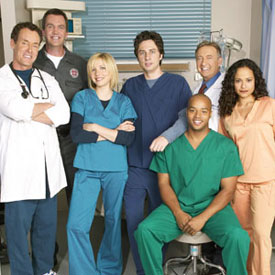 When I pointed out that if you are so desperate, you can buy them online, they all said "No, they must have 'Hospital property' printed on them". The world is full of some strange people, but if all my friends start appearing wearing blue scrubs, you know my kleptomania got the better of me over the summer.
Personally I blame e4, JD and Elliot. But there must be a reason why guys don;t want to sleep in scrubs?
Saturday, June 2, 2007
Elective (3)
I met with my Elective supervisor today. It starts in mid-July to mid-August, and has teh following aims & objectives.
My Summer Uniform?
- The elective will concentrate on peri-operative care of the patient
- It will focus on:
- physiological optimistaion;
- fluid balance,
- Analgesia
- Strategies to reduce morbidity in relation to surgery.
The idea is that in the first 2 weeks I will spend time visiting various areas of the Anaesthetic world, and can then focus down for 2 weeks on an area that interests me.

My Summer Uniform?
Subscribe to:
Posts (Atom)